
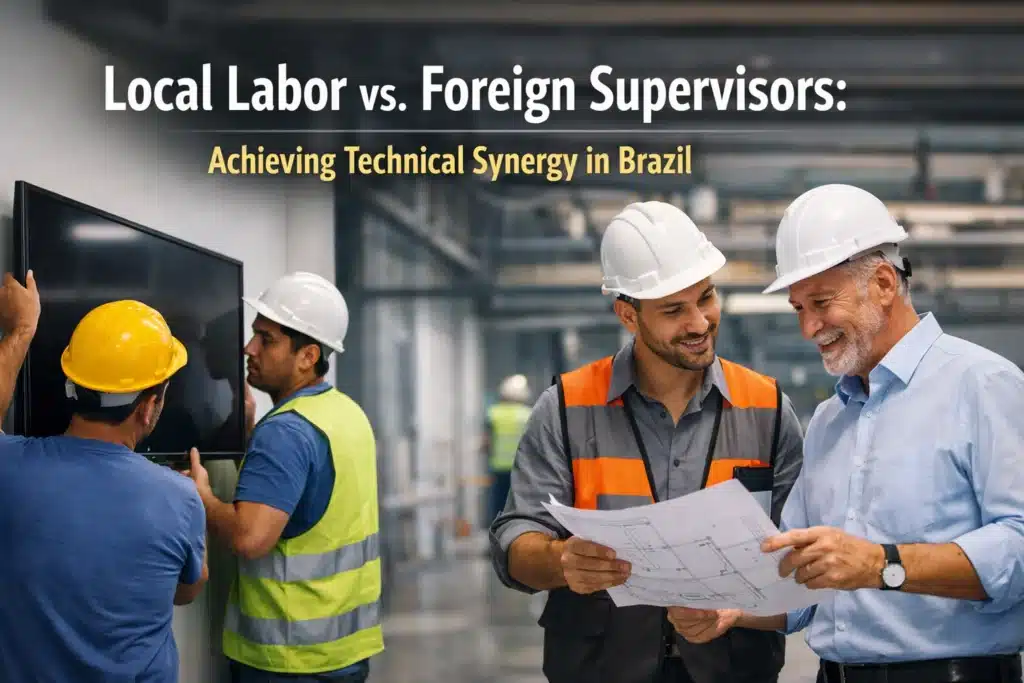
For global AV integrators and project designers, the Brazilian market represents a dual reality: a landscape of immense opportunity coupled with a labyrinth of operational complexity. When a high-stakes deployment: such as a corporate headquarters in São Paulo or a mission-critical operations center in Rio de Janeiro: reaches the installation phase, a fundamental question arises: Should you fly in your seasoned domestic team, or should you rely entirely on local labor?
The answer is rarely binary. Relying solely on foreign teams often leads to regulatory bottlenecks and exorbitant costs, while relying exclusively on local labor without specialized supervision can result in a disconnect from global quality standards. The most successful deployments in South America’s largest economy utilize a hybrid model. This article explores how to achieve technical synergy by balancing local execution with foreign oversight, while remaining strictly compliant with Brazil’s unique regulatory and labor frameworks.
The Compliance Landscape: NR10 and NR35 are Non-Negotiable
In the United States or Europe, safety certifications are often managed through private insurance requirements or industry-standard best practices. In Brazil, safety is governed by the Ministry of Labor through "Normas Regulamentadoras" (Regulatory Norms), or NRs. For AV and IT infrastructure projects, two specific certifications are non-negotiable: NR10 and NR35.
NR10 (Safety in Electrical Installations and Services): Any technician touching a rack, a power distribution unit, or even low-voltage cabling must be NR10 certified. This is not a one-time seminar; it is a rigorous training requirement that must be documented and updated.
NR35 (Work at Heights): Given that most AV projects involve ceiling-mounted projectors, displays, or overhead cable trays, NR35 is essential. Any work performed two meters above the floor level requires this certification.
Failure to provide proof of these certifications for every individual on-site can lead to immediate site shutdowns, massive fines, and: in the event of an accident: criminal liability for the project stakeholders. When you hire local labor through a partner like D2S, you ensure that every technician is fully credentialed, mitigating the risk that a foreign team member (who lacks these specific Brazilian certifications) might be barred from the site.

The Visa Trap: Why 'Business as Usual' is a Risk
A common mistake made by international integrators is sending their lead engineers to Brazil on a standard business or tourist visa. While this may pass at immigration for a two-day meeting, using these visas for "hands-on" technical work is a violation of Brazilian federal law.
The correct path for technical supervision is the RN03 (formerly known as the VITEM V technical visa). This visa is specifically designed for foreign technicians providing services under a contract or cooperation agreement.
- The Risk of Deportation: If a foreign supervisor is caught performing technical work on a tourist visa, they face immediate deportation and a multi-year ban from the country.
- Corporate Liability: The hiring company can be blacklisted from future contracts in Brazil, and the local client may face legal repercussions for allowing undocumented labor on their premises.
- The Solution: D2S assists partners in navigating the RN03 process, ensuring that if you do choose to send a foreign supervisor, they are legally protected. However, the costs and lead times associated with these visas often make a compelling case for the hybrid model.
The Hybrid Model: Local Hands, Global Standards
The most efficient way to deploy in Brazil is to combine a foreign Project Lead (who understands the global client’s specific standards and culture) with a local Technical Lead and Labor Crew provided by a partner like D2S.
This model creates a technical synergy that addresses three primary pain points:
1. Linguistic and Cultural Translation
Technical drawings and BOMs (Bill of Materials) are universal, but the nuances of local site conditions are not. A local Technical Lead acts as a bridge, translating the high-level requirements of the American integrator into actionable instructions for the local crew. This prevents the "lost in translation" errors that lead to expensive rework.
2. Equipment and Logistics
The logistical challenge of moving specialized tools and testing equipment across borders can be a project-killer. A local partner provides the specialized tools (from fusion splicers to calibrated audio processors) that are already in-country, avoiding the nightmare of temporary importation (Admission Temporária) and the risk of equipment being held in customs.
3. Cost Optimization
Flying a team of four technicians from the U.S. to Brazil involves airfare, high-end lodging, per diems, and the cost of the RN03 visas. By using a local D2S crew supervised by a single foreign engineer (or even a D2S supervisor trained in your specific standards), integrators can reduce labor-related costs by up to 60% without sacrificing quality.

30 Years of Infrastructure and Fiscal Integrity
When choosing a local partner to provide this "Technical Synergy," the most critical factor is the partner's fiscal and legal standing. Brazil’s labor laws (CLT) are protective of the worker, and "successor liability" means that if a local labor provider fails to pay their taxes or social security, the end client or the primary integrator can be held responsible.
D2S (DSCBS International LLC) brings 30 years of operational history in Brazil. Our "Clean Fiscal Record" is not just a point of pride; it is a shield for our clients. We handle all local payroll, social security contributions, and insurance, ensuring that your project is built on a foundation of total compliance.
Our technicians are not just general laborers; they are specialists trained in the AV/IT ecosystem. We understand the precision required for a high-end boardroom or a complex LED wall installation. By providing the local infrastructure: from the warehouse and transportation to the certified manpower: we allow you to focus on the design and client relationship.
Achieving Synergy: A Strategic Approach
To achieve true synergy, the engagement should begin during the pre-deployment phase. D2S works with your project designers to review the scope and identify potential local hurdles before the first crate arrives.
- Phase 1: Scope Review. We align your technical standards with local capabilities.
- Phase 2: Compliance Verification. We ensure all personnel have the required NRs and equipment.
- Phase 3: Execution. Your supervisor or our local lead manages the installation, maintaining a real-time link back to your home office.
- Phase 4: Closeout. We provide the local documentation and as-built verification required by Brazilian authorities.

Conclusion: Bridging the Gap
Expansion into the Brazilian market does not have to be an "either/or" proposition regarding labor. You do not have to choose between the high cost of foreign teams and the high risk of unvetted local labor.
The synergy provided by D2S offers a third way: a professional, compliant, and technically proficient bridge that brings your global standards to the Brazilian site. With three decades of experience and a deep understanding of both local regulations and international AV expectations, we are the partner of choice for integrators who demand excellence without the legal and financial headaches.
Consult with D2S for your technical staffing and deployment support. Let us help you navigate the complexities of Brazilian labor and logistics, ensuring your next project is a benchmark for international success.