
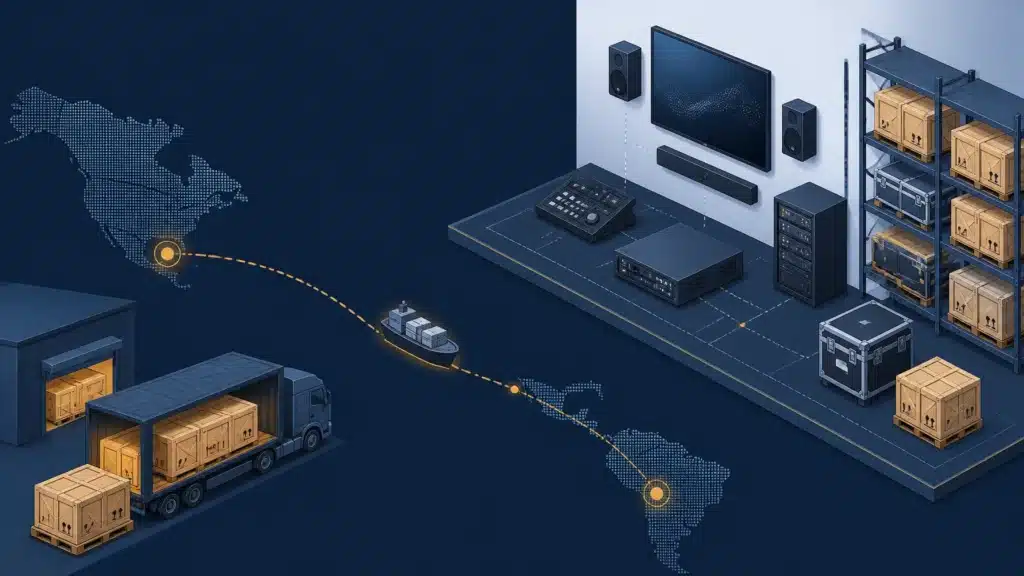
When planning an AV system, most of the attention naturally goes to technology.
Displays, speakers, control systems, connectivity, mounting, infrastructure, and system performance all have to work together. That is where the technical decisions are made: and where most design discussions begin.
But another part of the system can have just as much impact on whether a project succeeds:
How everything gets where it needs to go: and when.
Logistics is often treated as something that happens after the system has been designed. Products are ordered, boxes are shipped, and eventually equipment arrives at the jobsite.
For simple projects, that may be enough.
For complex deployments: especially multi-site rollouts, projects involving several manufacturers, or installations across the United States, Latin America, and the Caribbean: logistics needs to become part of the strategy from the beginning.
At DSCBS, we see logistics differently. It is not simply about shipping products. It is about orchestrating deployment.
The Hidden Complexity Behind an AV Deployment
Consider a project involving dozens of locations.
Equipment may come from several manufacturers, each with different lead times, warehouses, shipping requirements, packaging configurations, and delivery schedules. Some products may be ready immediately, while others may not be available for weeks.
At the same time, installation teams are working according to their own schedules. Construction milestones, site access, room readiness, loading docks, storage capacity, and local personnel all affect when equipment can actually be received and installed.
If products are shipped independently to each site, someone must coordinate multiple deliveries, verify inventory, manage storage, track missing components, and make sure installers have everything they need when they arrive.
One delayed component can disrupt an entire installation.
The problem is not necessarily the technology.
It is the logistics surrounding it.

Logistics Is More Than Transportation
In an AV project, logistics includes every activity between the purchase order and the moment equipment is ready for installation.
That can include:
- Coordinating procurement and vendor lead times
- Receiving equipment from multiple manufacturers
- Verifying quantities, models, and physical condition
- Capturing serial numbers and inventory information
- Organizing equipment by site, room, rack, or deployment phase
- Staging and consolidating shipments
- Coordinating freight and delivery windows
- Managing storage before the jobsite is ready
- Inspecting materials before installation
- Tracking exceptions, shortages, and damaged equipment
The AVIXA Xchange implementation framework places material procurement, logistics, delivery, installation, commissioning, and handover within a broader implementation process.
That structure matters because logistics is connected to every other phase of deployment. A change in design affects procurement. A procurement delay affects staging. A staging delay affects transportation. A transportation problem affects installation labor and the client’s schedule.
Treating logistics as a single line item called “equipment delivery” hides the actual work and the actual risks.
Consolidation Creates Control
This is where consolidation can simplify deployment.
The DSCBS Miami hub provides a centralized point where equipment can be received, organized, consolidated, and staged before continuing to its final destination.
Instead of products arriving independently from multiple sources, equipment can be coordinated around the needs of the actual deployment.
That creates greater visibility and control over what is moving through the project.
For multi-site installations, equipment can be organized according to location or deployment phase. Site-specific kits can be prepared before shipment, with the appropriate equipment grouped together for each installation team or rollout wave.
This reduces the amount of coordination required at individual jobsites.
Rather than asking:
“Did the equipment ship?”
The better question is:
“Is everything required for this installation ready?”
That is a very different approach to logistics.
Consolidation does not eliminate project risk. It makes the project easier to see and manage. Missing items can be identified earlier. Partial shipments can be tracked more clearly. Equipment can be aligned with the installation sequence instead of being released whenever an individual supplier happens to ship a box.

Timing Matters as Much as Transportation
Getting equipment to the correct location is only part of the challenge.
It also needs to arrive at the right time.
Too early, and the jobsite may not have secure storage available. Equipment can become an obstacle for other trades or face unnecessary risk of damage, loss, or misplacement.
Too late, and technicians may be standing onsite without everything they need to complete the installation.
Both scenarios create unnecessary cost.
Strategic staging helps align product availability with installation schedules. Equipment moves according to the deployment plan: not simply according to when individual boxes leave a warehouse.
For integrators working across multiple locations, timing becomes an operational control point.
A practical staging plan should answer questions such as:
- Is the room or site ready to receive the equipment?
- Who is responsible for receiving and inspecting it?
- How long can the equipment remain onsite before installation?
- Which materials are needed for each installation phase?
- Are all components for a room or rack available?
- What happens if one item is delayed?
- Can the shipment be redirected or held without disrupting the rollout?
The goal is simple: equipment should arrive neither too early nor too late.

Where and How to Transport
In most Latin American countries, tax characteristics vary by region. Brazil is no exception. In many cases, the situation is more complex.
The point of origin in the United States and the point of entry into Brazil are distinct factors that can affect local acquisition cost, transportation schedules, and equipment availability.
That creates practical questions for every project:
- Should the equipment move by air or sea?
- What is the applicable NCM classification?
- Which taxes and fees must be considered?
- What are the expected transit and clearance timelines?
- Will the client be ready to receive the shipment?
- What storage costs may apply if the site is delayed?
- Does the delivery sequence match the installation plan?
These questions should not be addressed after the equipment has already been purchased.
They should be part of the deployment plan.
All of these variables are part of the DSCBS Formula, designed to identify the most appropriate decision with tax and cost efficiency in mind. The right answer depends on the project, the equipment, the destination, the timeline, and the customer’s operational requirements.
There is no universal shipping method that works for every AV deployment.
Multi-Site Deployments Magnify Every Problem
A small logistical inefficiency on one project may be manageable.
Multiply it across 10, 50, or 100 locations, and it becomes expensive.
Multi-site deployments require repeatability. Equipment packages need to be consistent. Installation teams need predictable deliveries. Project managers need visibility. Stakeholders need confidence that one location will not fall behind because a critical component did not arrive.
Centralized logistics can help create that consistency.
Products from multiple manufacturers can be consolidated and staged according to the rollout schedule. Equipment can be organized by site, room type, floor, region, or deployment phase.
That allows deployment teams to focus less on chasing individual shipments and more on completing installations.
A repeatable process also makes it easier to identify exceptions. If every location is supposed to receive the same equipment package, a missing or incorrect component is easier to detect before the shipment leaves the staging point.

Miami: A Strategic Gateway
Location matters, too.
The DSCBS Miami consolidation hub is positioned to support projects throughout the United States while also serving as a gateway to Latin America and the Caribbean.
For manufacturers, integrators, and technology partners operating across these markets, Miami can provide a practical consolidation point for coordinating equipment before it continues to its final destination.
This becomes particularly valuable when projects involve:
- Multiple vendors
- Several countries
- Different shipping requirements
- Long or variable lead times
- Multiple installation phases
- Regional storage needs
- Coordinated delivery schedules
Instead of managing logistics as a collection of individual transactions, the project can be managed as a coordinated deployment.
That distinction matters. A shipment is a transaction. A deployment is a process with dependencies, milestones, responsibilities, and a defined outcome.
Logistics Can Become a Competitive Advantage
The AV industry spends a great deal of time talking about system performance.
We should also be talking about deployment performance.
A brilliantly designed system does not deliver value while its components are sitting in different warehouses, arriving at the wrong locations, or waiting for one missing piece.
The companies that manage deployment effectively can reduce delays, minimize unnecessary handling, make better use of installation labor, and create a more predictable experience for their customers.
That is why logistics should not be considered only after system design is complete.
It should be part of the design.
At DSCBS, our role extends beyond moving products from Point A to Point B. Through consolidation, staging, coordination, and our Miami hub, we help manufacturers, integrators, and technology partners turn complicated product movements into coordinated deployments.
For American AV integrators planning projects in Brazil or across the broader Latin American and Caribbean markets, the right time to address logistics is before the first purchase order: not after the first delivery problem.
Because when logistics is treated as a strategy, it does not just move equipment.
It moves projects forward.
If your next AV deployment involves multiple manufacturers, locations, or international delivery requirements, discuss the logistics plan early. A clear deployment strategy can help your team protect schedule, labor, cost, and client confidence before those factors are exposed to avoidable risk.
Keywords: AV logistics, AV system deployment, AV equipment consolidation, multi-site AV installation, AV staging, international AV integration, Brazil AV projects, Miami logistics hub, commercial AV integrators, Latin America AV deployment