
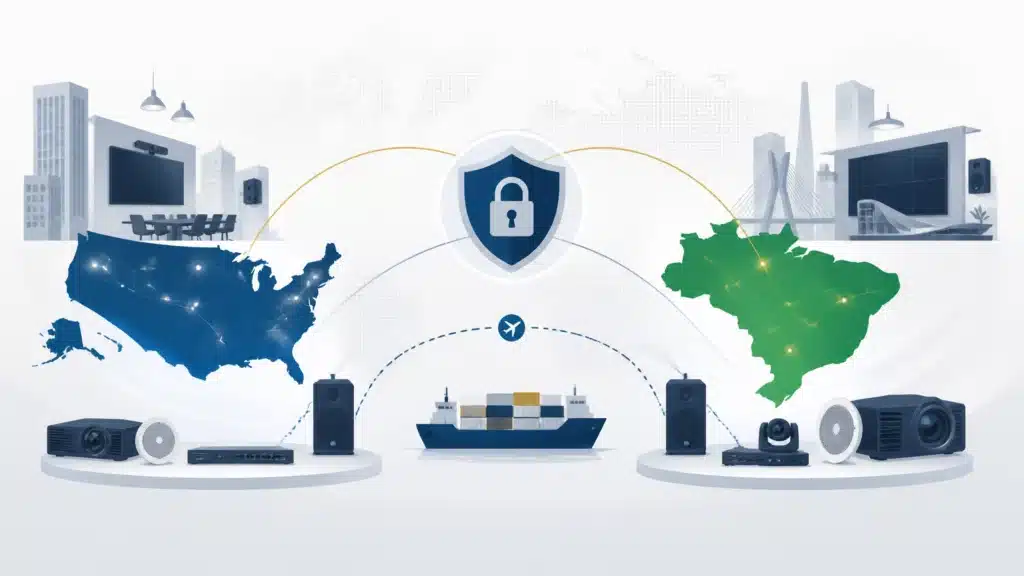
As Fortune 500 companies continue expanding operations into Brazil, many U.S.-based AV integrators are discovering that protecting the technology specification is only part of the equation. The bigger risk is protecting the customer relationship itself.
For years, international AV projects focused heavily on "spec protection" : ensuring the originally designed products and system architecture survived local procurement, substitutions, and deployment challenges. While that remains important, today's global projects face a more complex threat: commercial exposure.
When a U.S. integrator relies on a local Brazilian integrator to execute a project, they may unintentionally expose far more than the technical design. Pricing structures, deployment strategies, customer workflows, operational expectations, and long-term service opportunities can all become visible to a local company that may also compete for future business.
In many cases, the client's global headquarters pays the U.S. integrator in USD, while the U.S. integrator pays the local partner in BRL. That creates a visibility gap that can quickly become a commercial vulnerability. Once the local provider understands the customer's regional footprint, technology standards, support expectations, and pricing model, the U.S. integrator risks being bypassed entirely on future projects.
It has happened before.
Global enterprises often evolve toward regional sourcing once they believe they can work directly with a local provider. What begins as a deployment partnership can unintentionally become competitive displacement.
The Hidden Risk Behind "Local Support"

On paper, working with a local integrator sounds logical:
- Local labor
- Local procurement
- Faster deployment
- Portuguese-speaking teams
- Regional logistics support
But in practice, traditional local integration models can expose:
- Customer technology standards
- Enterprise deployment methodologies
- Pricing structures and markups
- End-user experience strategies
- Expansion roadmaps
- Support and managed services opportunities
For enterprise AV integrators, this is no longer simply a deployment concern. It is a customer experience (CX) protection issue.
Because once another company understands how your customer operates, how they standardize technology, and how they scale globally, your differentiator becomes vulnerable.
Protecting More Than the Spec
The challenge in Brazil is not just whether the specified products are available locally. It is whether the entire customer experience can be preserved without compromising the commercial relationship behind it.
That includes:
- Maintaining brand consistency across global offices
- Protecting system performance expectations
- Ensuring standardized workflows
- Preserving user experience from region to region
- Preventing unauthorized substitutions
- Avoiding channel conflicts and competitive exposure
This is where many traditional "local partner" models fall short.
Why DSCBS Takes a Different Approach

DSCBS was built specifically to solve this problem.
Rather than operating as a competing AV integrator, DSCBS functions as a logistics and deployment extension of the client and the originating integrator. The company's model is designed around protecting the commercial relationship while enabling successful project execution inside Brazil.
That means:
- No competing design services
- No customer poaching
- No competing sales strategy
- Transparent landed cost structure
- Controlled deployment workflows
- Local coordination without exposing the full business model
The goal is simple: allow global AV firms to expand into Brazil without sacrificing customer ownership, pricing integrity, or long-termed account control.
Instead of replacing the originating integrator, DSCBS strengthens their ability to deliver globally while remaining the trusted customer relationship holder.
Brazil Expansion Requires More Than Logistics

Brazil presents unique deployment realities:
- Import complexity
- Tax structures
- Currency fluctuations
- Product availability challenges
- Regional compliance requirements
- Local labor coordination
- Customs and shipping delays
But increasingly, the greatest risk is strategic visibility.
The companies winning global AV deployments today are the ones thinking beyond hardware delivery and asking a more important question:
"How do we protect the customer relationship while scaling internationally?"
Because protecting the specification is important. Protecting the business behind the specification is critical.