
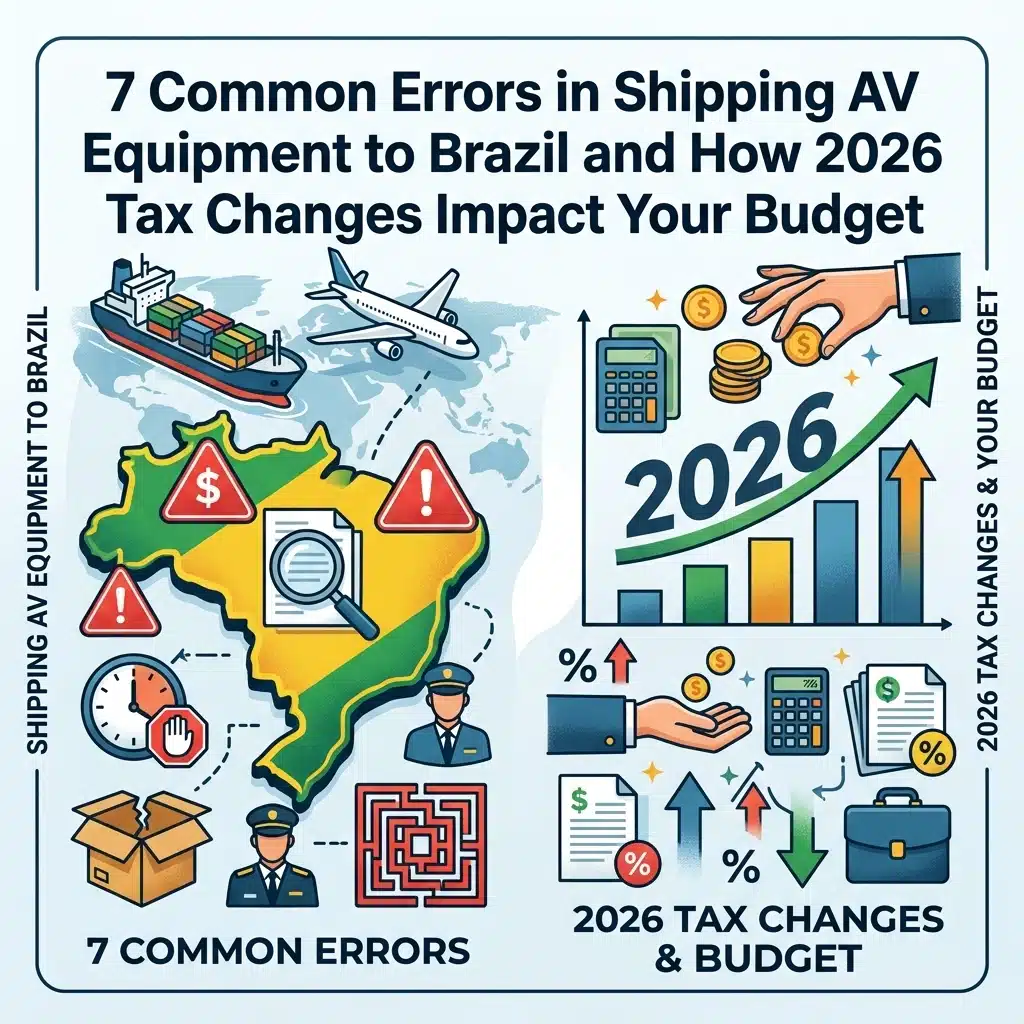
For American AV integrators, the Brazilian market represents a dual reality: a massive opportunity for high-end corporate and residential projects, and one of the most complex logistical landscapes in the world. As we navigate 2026, the complexity has shifted. While Brazil is in the midst of a historic tax reform, the fundamental pitfalls of importing sensitive audiovisual technology remain.
At D2S, with over 30 years of experience in specialized logistics and fiscal compliance, we have seen multimillion-dollar projects stall because of a single missing digit on a commercial invoice or a misunderstanding of the "Brazil Cost." Navigating this environment requires more than just a freight forwarder; it requires a strategic fiscal partner.
Below, we outline the seven most common errors that American integrators make when shipping to Brazil and how the 2026 tax landscape is redefining project budgets.

1. Utilizing Global Courier Services for Project Hardware
The most frequent mistake made by US-based firms is treating high-value AV equipment like a standard document or small consumer parcel. Utilizing major commercial couriers (like FedEx, DHL, or UPS) for professional integration gear is a high-risk strategy in Brazil.
In Brazil, courier shipments are subject to a "Simplified Tax Regime" (RTS), which is often capped at a specific value and carries a flat, high tax rate. However, professional AV equipment: such as LED processors, high-lumen projectors, and rack-mounted servers: often requires the "Formal Import" process. When these items arrive via courier without the proper pre-clearance, they are frequently seized by Receita Federal (Brazilian Customs). Once stuck, these items accrue daily storage fees that can quickly exceed the value of the equipment itself.
2. Miscalculating the Impact of the 2026 Dual VAT Transition
2026 marks a pivotal year for the Brazilian tax system. The country is currently transitioning from a fragmented system of five major taxes (PIS, COFINS, IPI, ICMS, and ISS) to a Dual VAT system: the CBS (Contribution on Goods and Services) and the IBS (Tax on Goods and Services).
Many integrators are still budgeting based on 2024 or 2025 rates. In 2026, we are seeing the "hybrid period" where both systems coexist. Failing to account for the new CBS rates: which apply to the import of goods: can lead to a 10% to 15% budget shortfall. D2S ensures that your pro-forma invoices are audited against the 2026 fiscal calendar to prevent these "hidden" costs from eroding your margins.
3. Shipping Used or Refurbished Equipment
Brazilian customs regulations are notoriously protectionist regarding "Used Goods." Shipping a "B-stock" projector or a refurbished media server is almost always a mistake unless you have obtained a specific, difficult-to-get import license beforehand.
Customs officials often interpret "refurbished" as "waste" or "unauthorized competition for local industry." If a shipment is flagged as containing used goods without prior authorization, the equipment is likely to be denied entry and ordered for immediate return or destruction at the shipper’s expense. For AV integrators, the rule is simple: only ship factory-new equipment with original packaging.

4. Incorrect NCM (HS Code) Classification
The Harmonized System (HS) is known in Brazil as the NCM (Nomenclatura Comum do Mercosul). Selecting the wrong NCM code is not just a clerical error; it is viewed as "tax evasion" or "misreporting" by Brazilian authorities.
AV equipment often falls into "gray areas." Is a smart display a monitor (higher tax) or a data processing unit (potentially lower tax)? The wrong choice can lead to heavy fines, often 1% to 10% of the total cargo value, and an automatic "Red Channel" (manual inspection) for all your future shipments. D2S’s fiscal team specializes in mapping US product descriptions to the precise NCM codes that ensure compliance while optimizing the tax burden.
5. Inadequate Documentation: The CPF/CNPJ Requirement
Every single shipment entering Brazil must be tied to a specific tax ID: the CPF for individuals or the CNPJ for companies. For American integrators working for a local Brazilian client, the shipment must be consigned to a legal entity in Brazil that is "Radar" enabled (authorized to import by the Federal Revenue).
We frequently see shipments arrive in Brazil addressed to "Project Manager at [Site Address]" without a CNPJ. These packages are held indefinitely. Ensuring your local client or your fiscal partner in Brazil has the proper "Radar" credentials is the first step in the logistics chain, not the last.

6. Misjudging Physical Packaging for "Tropical" Logistics
Logistics in Brazil involves more than just customs; it involves physical transit through varied climates and high-humidity environments. AV equipment is sensitive to electrostatic discharge (ESD) and moisture.
Standard cardboard boxing used for domestic US shipping often fails during the long-haul transit to Brazilian ports or airports. We recommend double-wall corrugation, vacuum sealing for high-end optics, and tilt/impact sensors for large-format displays. Furthermore, wood packaging must be heat-treated and carry the IPPC stamp (ISPM 15). If your crates arrive without this stamp, the shipment will be quarantined and potentially sent back, regardless of the contents.
7. Underestimating "Tax-on-Tax" Compounding in Budgets
The most shocking aspect for American CFOs is how Brazilian taxes are calculated: they are "compounded." In the 2026 transition, the base for one tax often includes the amount of another tax.
When you factor in the Import Tax (II), the new CBS, the IBS, and the IPI (Industrialized Products Tax), the effective tax rate can often exceed 60% to 80% of the CIF (Cost, Insurance, and Freight) value. Many integrators lose money on projects because they estimated a "flat 30%" tax rate. D2S provides a transparent "Landed Cost" analysis, so you know the exact dollar amount required to clear customs before the equipment even leaves your warehouse.

The 2026 Fiscal Landscape: A Strategic Overview
The implementation of the Tax Reform in 2026 is designed to eventually simplify the "Brazil Cost," but the current transition creates a "Dual System" complexity. As an American integrator, your primary concern should be Fiscal Compliance.
The Brazilian government has increased its use of AI and digital tracking to cross-reference the value of goods declared at customs with the payments made via international bank transfers. Discrepancies between the "Financial Flow" and the "Physical Flow" are a major red flag for audits.
D2S acts as your local "Eyes and Ears," ensuring that your fiscal strategy aligns with these new digital requirements. Our 30-year track record is built on the philosophy that logistics is not just about moving boxes: it is about managing risk and protecting the integrity of your project timeline.
Why AV Integrators Choose D2S
In the high-stakes world of AV integration, a delay of two weeks at customs can mean missing a grand opening or a critical corporate event. This leads to liquidated damages and a tarnished reputation.
D2S offers:
- Fiscal Pre-Audit: We review every invoice and NCM code before shipping.
- 2026 Tax Optimization: Navigating the CBS/IBS transition to protect your budget.
- Door-to-Door Visibility: Real-time tracking through the labyrinth of Brazilian customs.
- Compliance Certainty: 30 years of navigating Receita Federal regulations.
Streamline Your Next Brazilian Project
Don't let the "Brazil Cost" surprise you. If you are planning an AV integration project in Brazil for 2026 or 2027, the time to consult on your fiscal and logistical strategy is now.
Contact D2S today for a comprehensive Landed Cost Analysis and ensure your project stays on budget and on schedule.