
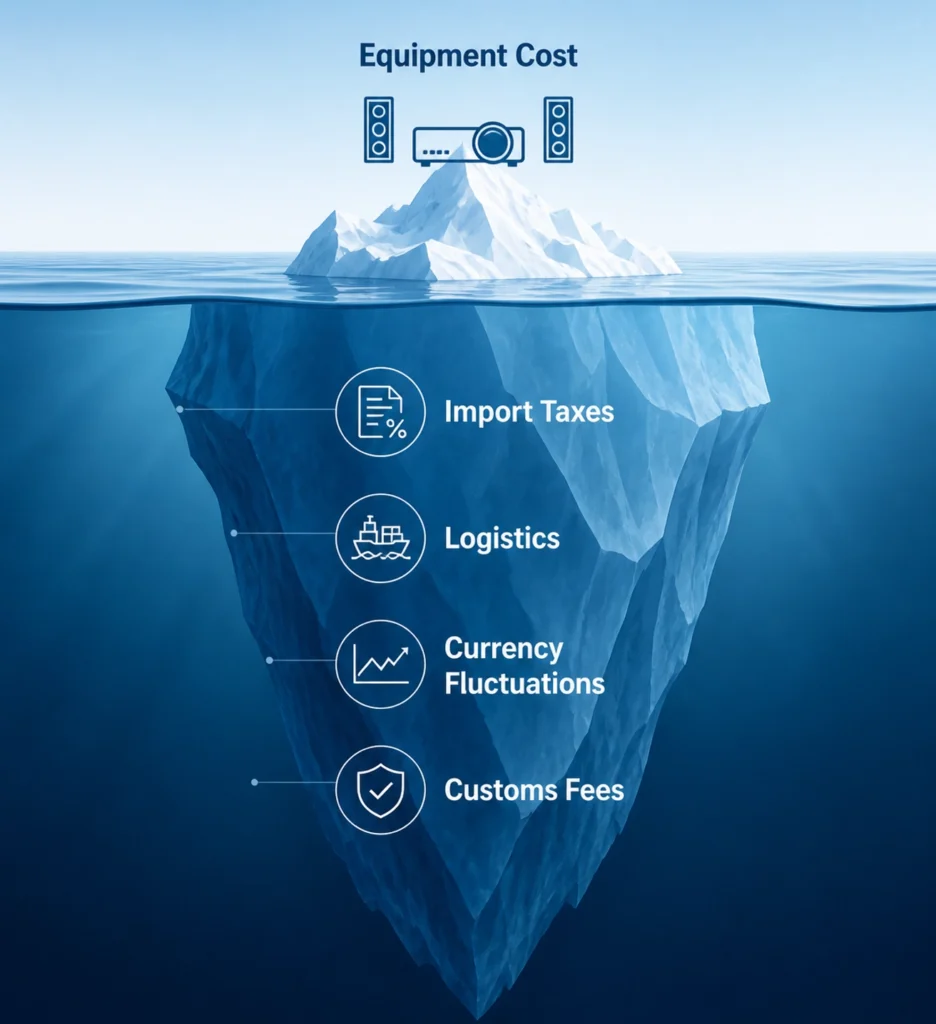
When planning an audio-video (AV) deployment in Brazil, many international manufacturers and system integrators make the same critical mistake: they compare the product price, not the project price.
On paper, the initial quote can look highly competitive. The equipment cost looks reasonable. Freight looks manageable. The timeline looks perfectly doable. Then Brazil shows up.
Unexpected import taxes. Extra customs costs. Aggressive currency swings. Storage fees stacking up by the day. Documentation delays. Local compliance requirements. Unplanned labor costs.
Suddenly, a project that looked profitable becomes significantly more expensive — or, in many cases, unprofitable. Brazil remains one of the largest and most dynamic AV markets in Latin America, but it is also one of the most complex from a logistics and cost-management standpoint. Understanding the real deployment cost is not optional if you want to protect project margin.
Beyond Purchase Price: The Illusion of the Initial Quote
Most American integrators are used to markets where landed cost is a simple equation: price + freight + a small duty. In Brazil, that logic breaks fast.
Unlike other markets, importing technology into Brazil involves multiple layers of taxation and regulatory requirements that go far beyond freight charges. Depending on the equipment, project structure, and import model, costs may include:
- Import Duty (II): Ad valorem tariffs that vary based on fiscal classification.
- Federal Taxes (IPI, PIS/COFINS-Import): Contributions that can dramatically increase the base cost.
- State Taxes (ICMS): A goods circulation tax that varies by state, making nationwide projects more complicated.
- Customs Clearance and Documentation Fees: Mandatory professional fees and bureaucratic charges.
- Domestic Transport and Last-Mile Logistics: The cost of moving sensitive equipment across a country with continental dimensions.
- Storage and Demurrage Fees: Punitive costs triggered by cargo release delays.
- Currency Conversion and IOF: Financial costs often ignored during the quoting phase.
Every one of these layers hits overall profitability directly. For companies not familiar with the Brazilian market, these variables are often left out of early estimates. The result is predictable: the budget blows up after the contract is already signed with the end client.

The Math of the Brazilian AV Market
Recent market data and information from AVIXA Xchange indicate that the total tax burden on imported AV hardware in Brazil typically lands between 35% and 45% of CIF value (Cost, Insurance, and Freight).
In practical terms, for complex systems such as LED video walls or high-performance conference rooms, the total cost of a fully installed and calibrated system in Brazil can reach 1.8x to 2.5x the original hardware price. If you are building your quote based only on the manufacturer price in the U.S., your margin is already gone before the shipment reaches port.
Currency Volatility Can Change Everything
Another hidden cost that catches many organizations off guard is currency volatility. Most international projects start with pricing in U.S. dollars (USD), while operational expenses, local taxes, and logistics fees in Brazil happen in Brazilian reais (BRL).
Between the moment a proposal is sent and the moment the equipment clears customs, the exchange rate may have moved enough to materially affect profitability. Without a strategy to manage currency exposure, and without predictability around clearance timing, integrators end up absorbing the difference. Margins disappear not because of technical project failure, but because external financial variables were never under control.

Hidden Fees Show Up When It Is Already Too Late
One import document filled out incorrectly. One wrong fiscal classification (NCM). One unmet local compliance requirement. In Brazil, a small bureaucratic mistake is often enough to start a chain reaction of cost.
These add-ons include:
- Storage fees while cargo waits for release in primary zones.
- Extra port handling costs triggered by physical inspections.
- Re-delivery expenses when local logistics are not aligned with the installation schedule.
- Expedited transport to recover time lost in customs.
- Schedule impact, creating idle costs for installation crews already on site.
What starts as a logistics problem quickly turns into a financial hole. Worse, client expectations and project milestones get hit, which damages the integrator's brand reputation in the international market.
Why Fixed Cost Visibility Is a Competitive Advantage
Successful international projects are not won by whoever finds the cheapest freight quote. They are won by whoever removes uncertainty.
- Project Managers need confidence that the budget approved on day one will still be accurate at completion.
- Finance Executives require predictable reporting with no surprise billing.
- Sales Teams need confidence when quoting global clients, knowing the final number will hold.
- Operations Teams need to ensure equipment arrives on time, without hidden costs showing up weeks after delivery.
That is where cost transparency becomes a strategic advantage. In a market as complex as Brazil, having a partner who can secure landed cost visibility and on-time logistics execution is the difference between profit and loss.
DSCBS: Delivering Financial Predictability in AV
At DSCBS, our job is not just moving boxes. Our role is to help international AV manufacturers and system integrators remove uncertainty from the entire deployment process in Brazil.
Through local expertise, commercial risk protection strategies, and end-to-end logistics management, we help clients understand their real costs before the project even starts. Instead of discovering extra charges along the way, DSCBS partners gain visibility into:
- Total Landed Cost: Know exactly what the equipment will cost delivered to the client site.
- Import Planning: Correct fiscal classification to avoid penalties.
- Local Logistics Coordination: Secure, scheduled transportation.
- Currency Risk Management: Protection against real volatility.
- Realistic Timelines: Schedules based on Brazilian operating reality, not generic assumptions.
The result is better budget accuracy, fewer surprises, and more consistent project outcomes.

The Real Advantage in the Brazilian Market
Winning business in Brazil is not just about offering the best technology. It is about delivering projects inside budget.
Clients remember when installations finish without surprise invoices. Finance teams value accurate forecasting. Project managers value execution without disruption. When costs are transparent, decisions get easier. When surprises disappear, profitability improves.
Build with Confidence
International AV projects are already complex enough without financial uncertainty added on top. Before your next deployment in Brazil, make sure you evaluate total cost — not just equipment cost. The most expensive surprises are usually the ones that never appeared in the original quote.
Avoid Budget Surprises
Planning your next AV deployment in Brazil? Contact DSCBS to discuss transparent pricing, predictable logistics, and end-to-end commercial protection. Keep your project — and your budget — on track.