
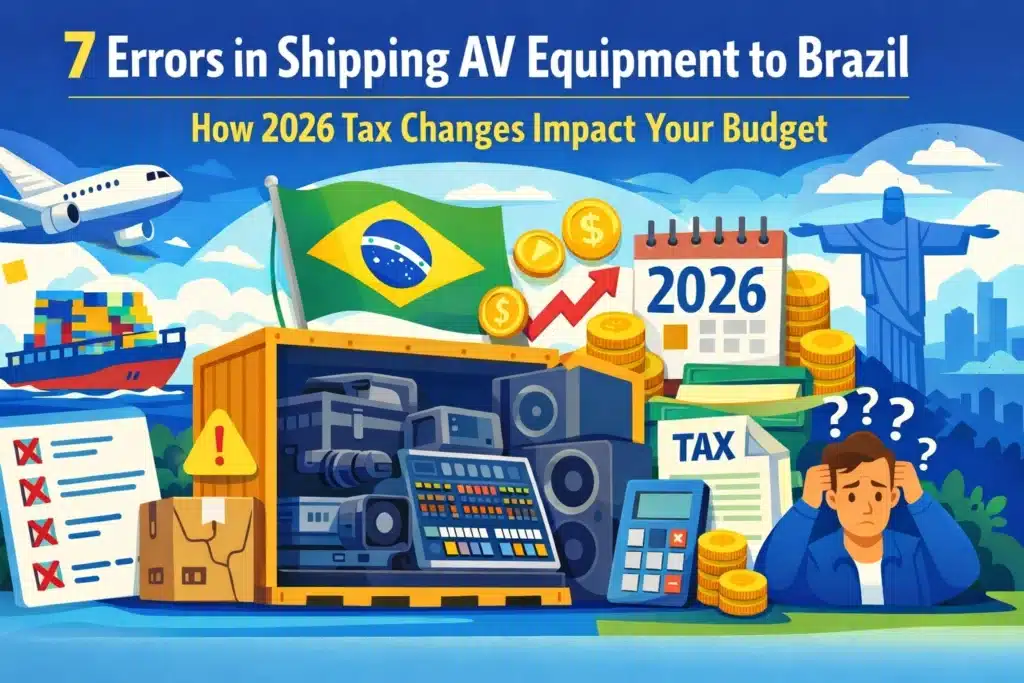
For US-based AV integrators and consultants, Brazil remains one of the most promising markets in Latin America. With continued investment in corporate infrastructure, command-and-control environments, and entertainment venues, demand for high-performance systems has never been higher. However, what should be a straightforward market expansion often turns into a logistics and budget nightmare due to Brazil’s customs and tax complexity.
It is March 2026, and the environment has shifted materially. Brazil’s long-anticipated tax reform has entered its practical transition phase, introducing new taxes and changing how international project budgets must be modeled. Ignoring these changes—or repeating classic import mistakes—can trigger unplanned costs that erode (or eliminate) an integrator’s margin.
In this article, D2S reviews seven common errors when shipping AV equipment to Brazil and explains how the 2026 tax framework affects your bottom line.
1. Incorrect Tax Classification (HS Codes and NCM)
The number-one mistake—and often the most expensive—is misapplying Brazil’s Mercosur Common Nomenclature (NCM), the regional implementation of HS codes. In AV, the line between a “computer monitor,” a “digital signage display,” and an “LED wall module” may seem minor to a non-specialist, but it can be material for Brazil’s customs authority.
A wrong classification can lead to penalties typically ranging from 1% to 10% of the shipment value, plus the tax difference and interest. In 2026, with the introduction of CBS (Brazil’s new federal goods-and-services contribution), accurate classification becomes even more critical because the transition/test rate treatment depends directly on the item’s technical nature.

(Illustration: A technical diagram comparing AV equipment categories and their respective tax classifications in a modern office environment.)
2. Ignoring the 2026 Tax Reform Transition
2026 is effectively a “test-drive” year for Brazil’s new tax system. For the first time, integrators are operating in a dual environment: the legacy framework (PIS/COFINS, IPI, ICMS) running alongside the new structure (CBS and IBS).
A common mistake in US financial planning is applying 2025 assumptions to 2026 projects. At this stage, CBS (federal) and IBS (state/municipal) begin to apply in trial/transition rates, while compliance complexity increases sharply. Budgets now must anticipate not only import cost but also residual cascading effects that can still exist during the transition. Failing to update your landed-cost model to reflect this duality is a direct path to margin loss.
3. Underestimating Customs Clearance Lead Times
In the US, “next-day delivery” is a baseline expectation. In Brazil, a higher-inspection cycle (often informally referred to as a “red channel” environment) can hold a shipment for weeks.
Many integrators commit to installation dates based on standard international logistics lead times without accounting for customs routing at ports like Santos or airports such as Viracopos. In 2026, higher volumes of technology imports have strained certain inspection channels. Planning for fewer than 21–30 days for full clearance is a strategic error that can damage credibility with the end client.
4. Inadequate Customs Valuation
Brazil’s customs authority uses sophisticated price benchmarking against international references. Attempting to declare AV equipment below market value to reduce taxes is a high-risk mistake. If an officer identifies that a 20k-lumen laser projector was declared at a fraction of its market price, the cargo may be held for a customs valuation review.
Beyond heavy penalties, this can place your company into a higher-scrutiny posture where future imports face more frequent physical inspections—delaying subsequent projects. Transparency on transaction value remains the only defensible approach under 2026 rules.

(Illustration: A bar chart comparing the financial impact of customs penalties versus the cost of correct compliance.)
5. Incomplete Documentation: Commercial Invoice and Packing List
Unlike many markets, Brazilian customs expects the Commercial Invoice and Packing List to be extremely detailed. Simple omissions—such as missing serial numbers, insufficient functional descriptions, or country of origin per line item—can stop the process immediately.
In 2026, with end-to-end digitization (Brazil’s Single Foreign Trade Portal), any mismatch between submitted data and the physical cargo triggers system errors that may take days to resolve through a broker-led correction workflow.
6. Choosing the Wrong Incoterm (DDP vs. DAP)
For many US integrators, offering DDP (Delivered Duty Paid) appears to simplify the client experience. In practice, without a qualified Brazilian entity (or a trusted partner such as D2S), DDP can be infeasible, because the importer of record must be a Brazilian company enabled to import under SISCOMEX/RADAR.
Using the wrong Incoterm can leave equipment stuck at the border because no party is legally able to pay duties/taxes or execute the clearance. “Import on behalf of” structures are often the most workable route—but they require early planning that many teams overlook.

(Illustration: Two shipping paths—one labeled “DDP without local support” ending at a barrier, and another labeled “Local partner” moving freely.)
7. Failing to Budget for Storage and Port/Airport Fees
An AV project budget in Brazil does not end with taxes. Storage fees at Brazilian ports and airports are often calculated as a percentage of cargo value and increase over time.
If high-value equipment is held due to a missing document, demurrage and storage can, in a matter of days, exceed the international freight cost. The error is not building a contingency line for port/airport charges into the budget presented to the end client. In 2026, with additional verification procedures tied to the tax transition, speed and accuracy at pickup is what separates a profitable project from a financial write-off.
The Direct Budget Impact in 2026
With CBS and IBS entering the transition, cost structure should become more transparent over time—but can be more volatile in the short term. The “Selective Tax” (often compared to a “sin tax”), while designed for goods harmful to health, has also created broader discussions around premium/luxury categories, reinforcing the need for ongoing monitoring by procurement and finance teams.
ROI modeling for a Brazil-based project should now consider potential tax credits that the local customer may recover under the new VAT-style framework. If a US integrator does not understand how the Brazilian client recovers credits, it can lose competitive ground to local firms that incorporate this into pricing and commercial strategy.

(Illustration: A consultant reviewing a digital worksheet showing legacy taxes versus CBS/IBS transition rates.)
Conclusion: Why a Strategic Partner Matters
Winning in Brazil’s AV market in 2026 requires more than technical excellence in sound and image engineering; it demands a disciplined logistics and tax strategy. The errors above are avoidable—but typically only with close collaboration with specialists who operate within Brazil’s real-world customs and compliance environment.
At D2S, we act as the logistics and deployment arm for global integrators, helping ensure the 2026 tax transition is managed as a controllable variable—not a margin-killer. Our expertise in AV product classification and our local presence allow your team to stay focused on what you do best: delivering reliable, high-performance AV outcomes.
If your next AV project is shipping to Brazil, consider a structured feasibility and landed-cost review before you commit dates and pricing. D2S can support an executive-level risk assessment focused on budget protection and predictable delivery.